KISS Review Framework
An action-orientated review model to convert past experience into practice.
The Golden Circle
For understanding how great leaders and orgs inspire action by starting with a clear sense of purpose.
AVP Model
A simple practice to accept the anxiety, anger or sadness and start embracing them.
7-38-55 Rule
Your presence speaks louder than your words.
TOPS Framework
Make your pitch or message clear, logical, and action-oriented.
Winston’s Star
Apply five communication elements to make ideas memorable and repeatable.
2 Minute Rule
Change up the content every two minutes to keep people engaged.
The Rule of Suspense
Reveal your points step by step.
PREP Framework
Deliver clear, structured arguments by stating your point first, proving it, and closing with clarity.
FIRE Model
Separate facts from interpretations to respond to feedback calmly and solve the real problem.
Zoom-In and Zoom-Out Model
Allows you to handle challenges with clarity, whether you need to see the big picture or focus on the details.
Self-Us-Now Framework
Help individuals and groups connect personal stories to collective action.
7C Pyramid Communication Framework
Aim to eliminate confusion and miscommunication in both verbal and written forms
Pixar Storytelling Formula
Turn complex ideas into clear cause-and-effect stories people remember.
Hero's Journey Storytelling Framework
A storytelling framework that makes your message relatable, memorable, and impactful in any context.
The Innovation Story Framework
Narrate how an idea was born, built, and scaled to demonstrate its real-world impact.
COST Principle
Help people to deliver strong messages or express complex ideas.
Magic Loop Framework
Capture feedback, act on it, make changes stick, and report back with clarity.
RIDE Communication Framework
Help you persuade effectively, build trust, and gain support in any professional setting.
Freytag’s Pyramid
Helps communicators control emotional rhythm and attention over time.
SCR Framework
Resolve complications with concise, executive-ready solutions.
SCQA Framework
Structure complex messages into a clear narrative that leads the audience to your conclusion.
Pyramid Principle
Structured communication framework which is supporting your point with logically organized details and effective information delivery.
Pixar Storytelling Formula: The 6-Step Narrative Structure
Turn complex ideas into clear cause-and-effect stories people remember.
Pixar Storytelling Formula
Quick Introcution
The Pixar Formula connects emotionally with audiences because it follows a logical and emotional progression. Each step builds upon the previous one, creating a cause-and-effect flow that deepens the audience’s engagement.
It moves beyond simply telling a story to make it memorable and impactful by showing growth, change, and relatable challenges.
The Pixar Storytelling Formula is a simple yet powerful storytelling framework that Pixar uses to create compelling stories with emotional depth and narrative flow.
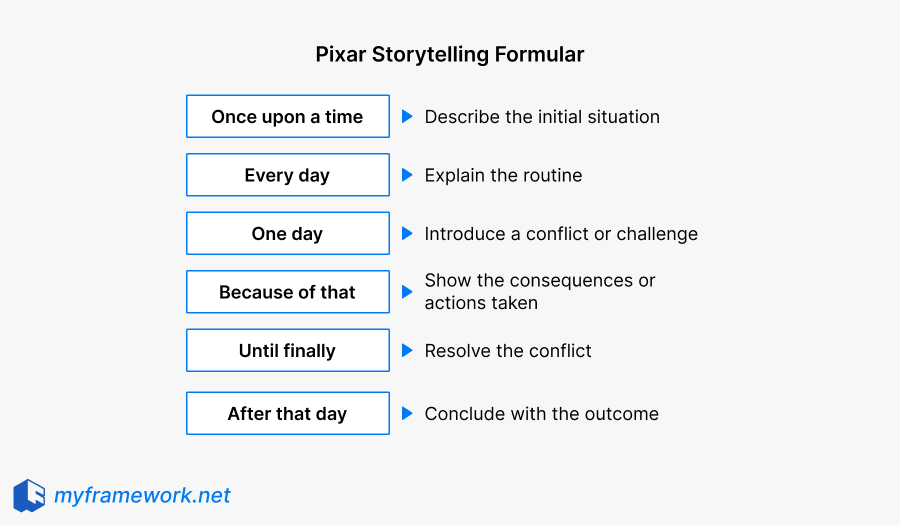
Known for captivating audiences across all ages, Pixar’s approach to storytelling can be broken down into a sequence often called the "Pixar Pitch," a structure that makes complex storytelling accessible and memorable.
The Structure of the Pixar Storytelling Formula
Once upon a time, there was…
Introduce the main character or setting to establish a baseline for the story.
Every day…
Describe the character's ordinary life, establishing their routine or normal world before any big changes.
Until one day…
Introduce a conflict or inciting incident that disrupts the character's normal life and propels the story forward.
Because of that…
Show the consequences of the inciting event, leading to a series of actions and reactions as the character faces new challenges.
Because of that…
Continue the chain of cause and effect, building momentum and emotional stakes as the character deals with increasing obstacles.
Until finally…
Reach the story’s climax, where the character faces their biggest challenge and resolves the main conflict.
And ever since that day…
Conclude the story by showing how the character or their world has changed, leaving the audience with a sense of resolution.