KISS Review Framework
An action-orientated review model to convert past experience into practice.
The Golden Circle
For understanding how great leaders and orgs inspire action by starting with a clear sense of purpose.
AVP Model
A simple practice to accept the anxiety, anger or sadness and start embracing them.
7-38-55 Rule
Your presence speaks louder than your words.
TOPS Framework
Make your pitch or message clear, logical, and action-oriented.
Winston’s Star
Apply five communication elements to make ideas memorable and repeatable.
2 Minute Rule
Change up the content every two minutes to keep people engaged.
The Rule of Suspense
Reveal your points step by step.
PREP Framework
Deliver clear, structured arguments by stating your point first, proving it, and closing with clarity.
FIRE Model
Separate facts from interpretations to respond to feedback calmly and solve the real problem.
Zoom-In and Zoom-Out Model
Allows you to handle challenges with clarity, whether you need to see the big picture or focus on the details.
Self-Us-Now Framework
Help individuals and groups connect personal stories to collective action.
7C Pyramid Communication Framework
Aim to eliminate confusion and miscommunication in both verbal and written forms
Pixar Storytelling Formula
Turn complex ideas into clear cause-and-effect stories people remember.
Hero's Journey Storytelling Framework
A storytelling framework that makes your message relatable, memorable, and impactful in any context.
The Innovation Story Framework
Narrate how an idea was born, built, and scaled to demonstrate its real-world impact.
COST Principle
Help people to deliver strong messages or express complex ideas.
Magic Loop Framework
Capture feedback, act on it, make changes stick, and report back with clarity.
RIDE Communication Framework
Help you persuade effectively, build trust, and gain support in any professional setting.
Freytag’s Pyramid
Helps communicators control emotional rhythm and attention over time.
SCR Framework
Resolve complications with concise, executive-ready solutions.
SCQA Framework
Structure complex messages into a clear narrative that leads the audience to your conclusion.
Pyramid Principle
Structured communication framework which is supporting your point with logically organized details and effective information delivery.
The Rule of Suspense
Why Attention Fades So Easily
Great communicators know how to keep people curious. They build anticipation instead of revealing everything at once.
This is what we call the Rule of Suspense in communication.
The Rule of Suspense is a simple but powerful communication method that helps you keep your audience engaged by sharing your points one at a time. The core concept of this technique is simple and straight:
Instead of listing all your ideas upfront, you reveal them step by step. Each point becomes a small discovery, giving your audience a reason to stay focused.
When someone says, “I have three ideas to share. They are A, B, and C,” the listener’s curiosity disappears instantly because they already know what’s coming.
But when the speaker says, “I have three ideas to share. The first is…,” the audience starts to anticipate what the next one will be.
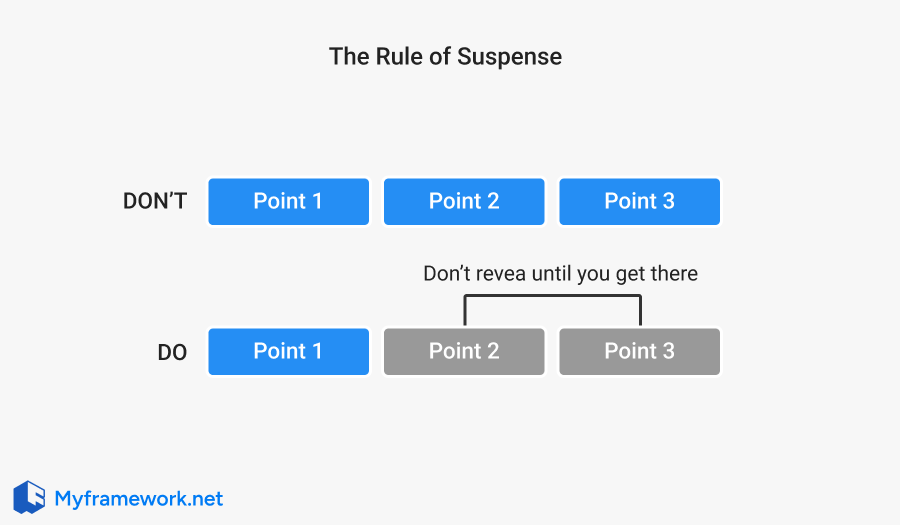
This creates momentum and keeps the listener invested.
Core Concept of the Rule
At its heart, the Rule of Suspense is about sequencing and curiosity.
- Sequence matters. Presenting points one at a time allows each idea to stand on its own. The listener can absorb, react, and reflect before moving to the next part.
- Curiosity drives attention. When people do not know what’s next, their brains stay alert. It’s the same principle that keeps us watching movies or reading stories until the end.
- Emotional engagement builds memory. Suspense creates a small emotional gap between what we know and what we want to know. Filling that gap makes information more memorable and persuasive.
This method is widely used in storytelling, sales, and presentations because it mirrors how human attention naturally works.