KISS Review Framework
An action-orientated review model to convert past experience into practice.
The Golden Circle
For understanding how great leaders and orgs inspire action by starting with a clear sense of purpose.
AVP Model
A simple practice to accept the anxiety, anger or sadness and start embracing them.
7-38-55 Rule
Your presence speaks louder than your words.
TOPS Framework
Make your pitch or message clear, logical, and action-oriented.
Winston’s Star
Apply five communication elements to make ideas memorable and repeatable.
2 Minute Rule
Change up the content every two minutes to keep people engaged.
The Rule of Suspense
Reveal your points step by step.
PREP Framework
Deliver clear, structured arguments by stating your point first, proving it, and closing with clarity.
FIRE Model
Separate facts from interpretations to respond to feedback calmly and solve the real problem.
Zoom-In and Zoom-Out Model
Allows you to handle challenges with clarity, whether you need to see the big picture or focus on the details.
Self-Us-Now Framework
Help individuals and groups connect personal stories to collective action.
7C Pyramid Communication Framework
Aim to eliminate confusion and miscommunication in both verbal and written forms
Pixar Storytelling Formula
Turn complex ideas into clear cause-and-effect stories people remember.
Hero's Journey Storytelling Framework
A storytelling framework that makes your message relatable, memorable, and impactful in any context.
The Innovation Story Framework
Narrate how an idea was born, built, and scaled to demonstrate its real-world impact.
COST Principle
Help people to deliver strong messages or express complex ideas.
Magic Loop Framework
Capture feedback, act on it, make changes stick, and report back with clarity.
RIDE Communication Framework
Help you persuade effectively, build trust, and gain support in any professional setting.
Freytag’s Pyramid
Helps communicators control emotional rhythm and attention over time.
SCR Framework
Resolve complications with concise, executive-ready solutions.
SCQA Framework
Structure complex messages into a clear narrative that leads the audience to your conclusion.
Pyramid Principle
Structured communication framework which is supporting your point with logically organized details and effective information delivery.
7C Pyramid Communication Framework: A Checklist for Clarity
Aim to eliminate confusion and miscommunication in both verbal and written forms
7C Pyramid Communication Framework
We Need Clear Messages
Effective communication is the cornerstone of success, whether you’re navigating the boardroom, delivering a presentation, or simply having a conversation. But how can you ensure your message is clear, precise, and impactful?
Here comes the 7C Pyramid communication framework, a powerful model designed to optimize how we convey information in any setting.
Whether you're a businessman making crucial decisions or a college student working on a group project, mastering these principles can significantly elevate the quality and effectiveness of your communication.
What is the 7C’s Model
The 7C Pyramid Communication Framework is a guideline for workplace communication, it provides a clear structure for building stronger communication skills, ensuring that every message is effective and easy to understand.
The model was developed by Scott M. Cutlip and Allen H. Center, renowned scholars in the field of public relations and communication. Their work in the mid-20th century sought to improve how businesses and organizations communicate with their audiences.
Initially targeted at public relations professionals, the model quickly gained traction across various communication disciplines for its practical and straightforward approach to effective messaging.
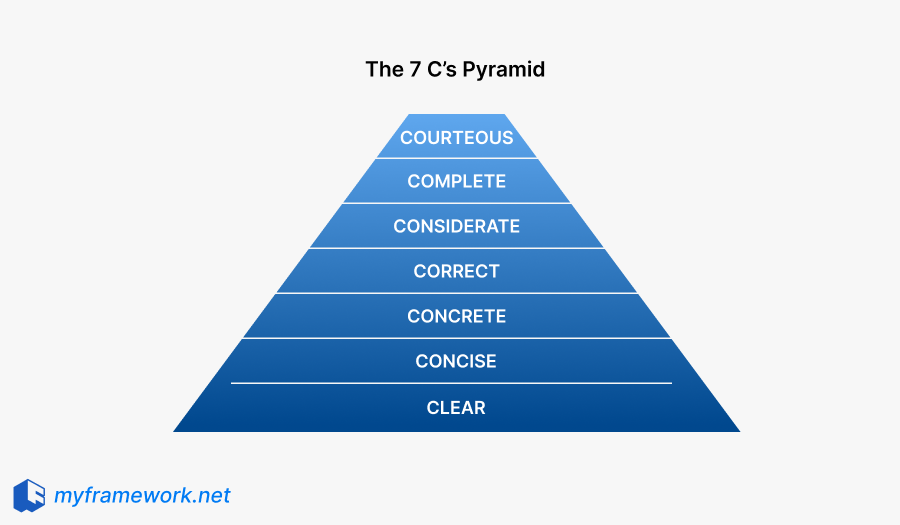
It defines seven essential qualities that make communication successful: Clarity, Conciseness, Concreteness, Correctness, Consideration, Completeness, and Courtesy: act as a checklist to ensure that messages are impactful, easy to understand, and tailored to the audience’s needs.
Core Concept of 7C's Pyramid
Clear
The foundation of effective communication is clarity.
The message should be clear and straightforward, avoiding ambiguity. Ensure that the purpose of your message is easily understood by the audience, and that language and terminology are simple and accessible.
Tips of Usage
- Use simple languages
- Avoid jargon unless necessary
- Provide context when needed
Concise
Be concise in your communication.
Avoid unnecessary details, and eliminate jargon or filler words. Deliver your message in as few words as necessary, without leaving out essential information. The goal is to convey your message efficiently without losing its meaning.
Tips of Usage
- Get to the point quickly
- Eliminate necessary words
- Use bullet points for easy digestion
Concrete
Ensure your message is specific, definite, and backed by facts. Concrete communication helps the audience grasp the message more easily and minimizes misunderstandings.
For example, use statistics, examples, and clear language that describe facts rather than vague statements.
Tips of Usage
- Use tangible facts and figures
- Provide real-world examples
- Avoid vague generalizations
Correct
Use the correct language, grammar, and spelling in your communication.
Correctness also involves ensuring that your message is suitable for the audience in terms of language, tone, and formality. It reflects professionalism and attention to detail.
Tips of Usage
- Double-check facts and figures
- Use proper grammar and spelling
- Cite source when appropriate
Considerate
Always consider the audience’s perspective, needs, and expectations. Tailor your message in a way that resonates with them, taking into account their background, emotions, and level of understanding.
Empathy in communication leads to stronger connections and better reception.
Tips of Usage
- Organzie thoughts sequencely
- Use transition words effectively
- Maintain a consistent tone
Complete
Ensure that your message includes all necessary information for the recipient to understand and act upon.
A complete message answers any potential questions the audience may have and provides sufficient context, ensuring nothing important is left out.
Tips of Usage
- Using 5W1H model
- Anticipate and address potential questions
- Offer next steps or calls to action
Courteous
Be polite, respectful, and considerate.
Courtesy is about being tactful and showing respect for the audience’s values, feelings, and perspectives. A courteous approach helps to foster goodwill and trust in communication.
Tips of Usage
- Use polite language
- Show empathy and understanding
- Be inclusive and mindful of diverse perspectives